


Plants vs. Zombies™
ELECTRONIC ARTS
The first time I played Plants vs. Zombies™, I understood why this strategy game has remained so recognizable for so long. The idea is simple: protect a home from waves of zombies by placing plants that attack, slow, block, or otherwise control the lanes. Yet the appeal is not just the cartoon presentation. The game turns space, timing, and resource management into small decisions that are easy to understand and surprisingly satisfying to improve.
I tested it as the kind of game I might keep on my phone for short breaks rather than as a single weekend distraction. That distinction matters. The opening hours are immediately inviting, but the real question is whether the game still deserves attention after the novelty of planting sun-producing flowers and stopping the first zombies has faded. My answer is mostly positive, with some important limits: it is excellent for compact strategy sessions and gradual experimentation, but less suitable if you want a constantly changing competitive experience or dislike repeating familiar patterns.
Why the first week works so well
The early experience is unusually good at teaching without making the player feel taught. Each new plant gives me a reason to rethink the lawn, while each new zombie asks whether my current arrangement is actually reliable. I am not simply choosing the strongest units. I am deciding how quickly to build an economy, where to spend limited sunlight, and which lane can survive if the attack becomes uneven.
Related News

Canva on Mobile Is Excellent for Most Creators, but Not Every Workflow
Frost & Flame: King of Avalon – A Medieval Strategy Masterpiece

Why Canva’s Creative Community Keeps Its Design App Useful
That makes the game approachable for people who normally avoid strategy titles. I do not need to learn a complicated interface before making useful decisions. The board is readable, the lanes are clear, and the visual style keeps danger understandable even when several things happen at once. At the same time, a careless opening can leave me with too little income or a weak lane, so the simplicity never becomes completely automatic.
One of the best early habits is to treat the first minutes of a level as preparation rather than combat. I try not to fill every available space immediately. Leaving room for a defensive response is often more valuable than spending all available sunlight on damage. This is a small but important lesson: a board that looks powerful now can become awkward when a tougher zombie requires a different answer.
Related News

Why WhatsApp Messenger Still Makes Everyday Communication Feel Easy

Jurassic World: The Game Is the Better Dino Tycoon for Strategic Players

Threads in Real Life: Who Should Join, Lurk, or Leave

How SHEIN Turned Shopping Into an Endless Content Feed

How to Make Fortnite Feel Smarter on Mobile

Should You Switch to Microsoft Outlook on Mobile?
The game also handles short sessions well. A level can fit into a break, but it still gives me enough time to form a plan and see whether that plan works. If I lose, the failure usually feels understandable. I can often identify the mistake: I protected the wrong lane, delayed my economy, reacted too late, or relied too heavily on one type of plant. That clarity encourages another attempt instead of creating the feeling that the result was random.
For a realistic everyday scenario, I can imagine opening it while waiting for an appointment or during a commute break, completing a level, and closing it without needing to remember a complex storyline. The game does not demand a long uninterrupted evening. Its strongest routine is a handful of focused rounds spread across the day.
The presentation helps the first week considerably. The plants and zombies have distinct personalities, and their exaggerated designs make the battlefield easy to scan. I can usually tell what is happening without pausing to inspect tiny icons. That accessibility is especially useful on a phone, where crowded interfaces can make strategy games tiring before the strategy even begins.
Gallery
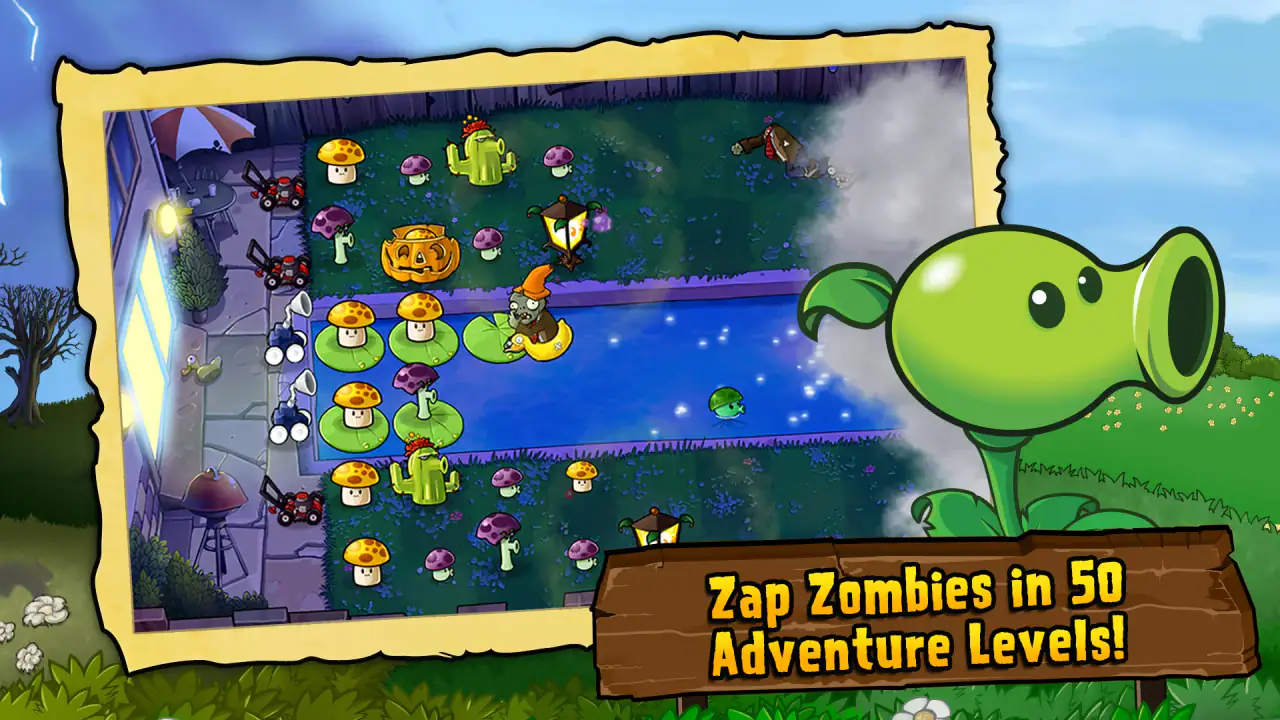
Still, the first-week charm is not only visual. The real hook is the steady rhythm of discovering a plant, testing it, and then finding a level where it becomes unexpectedly useful. A plant that seems ordinary in one situation may become a key part of a defensive arrangement later. I enjoy that the game rewards understanding combinations rather than simply collecting options.
Small decisions that improve early play
I found it useful to separate plants into jobs rather than judging them only by their attack power. Some create the resources needed to maintain a defense, some buy time, and some solve a specific threat. Thinking in those roles prevents a common beginner mistake: selecting a lineup full of attackers and then discovering that there is no stable way to support them.
Another practical tip is to watch the lane that appears quiet. A calm lane can tempt me to ignore it, but saving a response for that space is often safer than assuming the pressure will remain elsewhere. The game rewards looking at the whole lawn instead of staring at the most dramatic attack.
I also prefer rebuilding a weak plan rather than stubbornly repeating it. If a level exposes a clear problem, changing one or two plants can teach more than making the same placement slightly faster. This makes the game feel like a puzzle with a tactical surface, not just a test of reflexes.
What remains valuable after the novelty fades
After the initial discovery period, the game’s value comes from refinement. I begin to recognize which openings are dependable, which plants are flexible, and which defensive ideas are too slow for a particular level. That knowledge creates a modest but real sense of mastery. I am not merely progressing through content; I am building a mental library of responses.
This is where the game differs from many casual alternatives. A match-three title may offer faster individual moves, while an action game may depend more on reflexes. Here, the satisfaction comes from arranging a system and watching it hold under pressure. Compared with a real-time competitive strategy game, it is far less demanding socially and technically. I can play alone, pause my attention between rounds, and improve without facing another person’s unpredictable decisions.
That comparison also reveals the trade-off. Players who enjoy constantly changing opponents, live rankings, or a deep multiplayer meta will probably find this experience limited. Its strength is controlled, self-contained strategy. It does not need competition to be enjoyable, but it also cannot provide the endless variety that comes from competing against human players.
The recurring value is strongest when I approach levels as experiments. Instead of rushing only to unlock the next part, I can replay a difficult stage with a different balance of economy, defense, and offense. This is one of the less obvious reasons to keep the game installed: familiar levels become useful practice spaces for understanding timing and board control.
There is also value for families and younger players who want a readable introduction to strategic thinking. The content rating is Everyone 10+, and the playful tone keeps the conflict light rather than grim. I would still consider the individual child’s comfort and patience, but the game is much easier to discuss with a younger player than a darker or more complicated strategy title.
For adults, it works best as a low-pressure mental break. I can play when I want more involvement than scrolling but less commitment than a long role-playing game. The levels ask me to pay attention, yet they do not require a large amount of narrative memory or a lengthy session to feel worthwhile.
How to make the middle period less repetitive
Once I know the basic patterns, I deliberately avoid using the same comfortable lineup for every situation. A familiar setup may win, but it can hide the game’s more interesting decisions. Trying a plant that solves a different problem forces me to reconsider the order in which I build the board and often reveals a safer response than my default approach.
I also recommend judging a strategy by how well it handles mistakes, not only by how quickly it wins. A fragile arrangement can look impressive when everything goes correctly but collapse from one missed placement. A slightly slower plan with spare space and a backup answer is usually more satisfying over repeated attempts because it reduces the need to restart after one error.
Players wondering whether progress requires spending money should approach the game with a clear personal limit. It is free to download, while in-app purchases range from $0.99 to $7.99 per item. I would not treat optional spending as part of the core reason to try it. The better question is whether the basic experience already fits your habits. If the answer is no, purchases will not solve the underlying issue of repetition or limited variety.
Maintenance, repetition, and the cost of keeping it installed
The maintenance burden is low in one sense: this is not a game that asks me to manage a complicated daily schedule just to remain competitive. I can leave it alone and return later without feeling that I have fallen behind another player. That makes it easier to keep as a casual standby than games built around constant check-ins.
However, low maintenance does not mean unlimited freshness. The game’s recurring value depends on whether I enjoy replaying situations with better planning. If I need a constant stream of new mechanics, the routine may eventually feel narrow. The core pleasure is stable rather than endlessly expanding, so it rewards players who like polishing decisions more than chasing novelty.
One source of fatigue is repetition in the basic rhythm. Resource production, lane defense, and timed responses remain central throughout the experience. That consistency is what makes the game accessible, but it can also make later sessions feel familiar rather than surprising. I notice this most when I play for too long in one sitting. Shorter sessions preserve the sense of control; extended sessions make the repeated structure more obvious.
Another possible frustration is that failure can come from an early decision whose consequences appear much later. If the opening economy is weak, I may spend the rest of the level trying to recover. That is strategically fair, but it can feel harsh when I am experimenting with an unfamiliar setup. The solution is to restart confidently when the foundation is clearly flawed instead of trying to rescue every bad opening.
The game is also not the ideal choice for someone seeking a relaxed experience with no pressure at all. Although the artwork is friendly, some levels still demand concentration and quick prioritization. I would not describe every session as passive background entertainment. The best results come when I give the lawn my full attention for a few minutes.
On the other hand, it is a good option for players who dislike the maintenance demands of competitive mobile games. There is no need for me to compare my performance with a live opponent or protect a ranking. I can return because I want to solve a level, not because the game has made absence feel costly. That difference gives it a healthier place in my phone routine.
Who should keep it, and who should move on
I would keep it installed if I wanted a dependable single-player strategy game with clear rules, compact sessions, and enough room to improve through experimentation. It suits people who enjoy planning a defense, spotting weaknesses, and learning from a failed arrangement. It is also a strong pick for someone introducing a younger player to lane-based strategy without starting with a dense interface.
I would skip it if my priority were deep online competition, frequent content changes, or a story that carries the experience from one session to the next. I would also hesitate to recommend it to anyone who becomes bored by replaying familiar tactical structures. In that case, a more dynamic multiplayer strategy game or a puzzle game with constantly changing boards may offer better long-term variety.
The average rating is 3.9 from around 5.8 million ratings, with roughly 117 thousand written reviews. Those figures suggest a very large audience with a generally favorable but not universally enthusiastic response. That matches my impression: the core design is polished and approachable, while individual tolerance for repetition and monetized extras will shape the experience considerably.
Electronic Arts is the developer, and the game has passed 500 million installs. It first appeared on November 13, 2014, and the current version is 3.14.0. It supports Android 5.0 and later, so compatibility is broad for older devices, although actual comfort will still depend on screen size and how smoothly a particular phone handles the game.
My long-term verdict
After the first-week excitement wears off, Plants vs. Zombies™ earns its space through dependable, self-contained strategy rather than constant reinvention. I can return for a short session, test a new arrangement, and leave without feeling that I have neglected a larger obligation. That is a meaningful advantage in a mobile game category often built around reminders, competition, and pressure to check in.
Its limitations are equally clear. The central loop remains recognizable, and players who need continuous novelty may eventually feel that they have seen the main idea. Some levels can punish weak openings, while optional purchases may make the free experience feel less complete for people who prefer everything to be available immediately. These are not reasons to dismiss it, but they should shape expectations before installing.
For me, the lasting appeal comes from the balance between friendliness and consequence. The plants look amusing, the zombies are easy to read, and the rules are welcoming, yet careless resource use can still ruin a plan. That combination makes each successful defense feel earned without turning every round into a stressful contest.
The game is free, rated Everyone 10+, and remains easy to recommend when someone asks for a strategy title that works in short bursts. I would describe it as a reliable habit rather than an endless hobby: excellent when I want a few focused minutes of tactical problem-solving, less compelling when I demand a constantly evolving game world. If that distinction fits what you want from your phone, it is still worth planting a few defenses and seeing whether the lawn becomes part of your regular routine.
FAQs for Plants vs. Zombies™
What is the main objective of Plants vs. Zombies™?
In Plants vs. Zombies™, your main objective is to defend your home from waves of zombies using an array of unique plants. Each plant has distinct abilities, and strategic placement is essential to ward off the advancing undead. The game combines strategy and action, challenging players at every level.
Is Plants vs. Zombies™ free to play?
Plants vs. Zombies™ offers a free version with optional in-app purchases. While you can progress through the game without spending money, these purchases can enhance your gameplay experience by providing additional plants, power-ups, or unlocking new levels faster. It's designed to be enjoyable with or without spending money.
Can I play Plants vs. Zombies™ offline?
Yes, Plants vs. Zombies™ can be played offline, making it a great option for gaming on the go without the need for an internet connection. However, some features, such as updates or certain in-app purchases, may require an online connection to access or perform.
What age group is Plants vs. Zombies™ suitable for?
Plants vs. Zombies™ is generally suitable for all ages, offering a fun and engaging experience for both children and adults. The game features cartoonish graphics and humorous content, making it family-friendly. However, parents may want to monitor younger children due to in-app purchases.
Are there different modes or levels in Plants vs. Zombies™?
Plants vs. Zombies™ includes various modes and levels, such as Adventure Mode, Mini-Games, and Puzzle Mode, providing diverse gameplay experiences. Each mode offers different challenges, encouraging players to use different strategies and plant combinations to defeat zombie hordes effectively.
Pros
- Engaging tower defense gameplay.
- Charming graphics and animations.
- Wide variety of plants and zombies.
- Easy to learn
- hard to master.
- Regular updates and events.
Cons
- Requires in-app purchases for faster progress.
- Some levels can feel repetitive.
- Energy system limits playtime.
- Ads can be intrusive at times.
- No offline mode available.


